The groove theory of habits
In The Inner Game of Tennis, W. Timothy Gallwey writes about the groove theory of habits. The theory posits that in golf, tennis, and similar sports, every time you swing a club or racket a certain way, you increase the likelihood of swinging that way again. By doing so, Galloway writes, “patterns, called grooves, build up which have a predisposition to repeat themselves.” Fighting these habits and deep mental grooves is a painful, slow process and a major source of frustration. It’s a lot like trying to dig yourself out of a trench. The more natural way, he suggests, is to consider how a child learns any new skill, like walking: “A child doesn’t have to break the habit of crawling, because he doesn’t think he has a habit; he simply leaves it as he finds walking an easier way to get around… Starting new patterns is easy when done with the childlike disregard for imagined difficulties.”
I was thinking about how this applies outside of sports. The mental grooves and old habits that determine how we swing a racket are similar to the unchallenged assumptions or inherited beliefs that shape how we work and think in business, art, writing, music, and many other fields. The “imagined difficulties” of challenging the status quo can inhibit new ideas or creative breakthroughs.
So this week I’m sharing three examples of people who have shown a childlike disregard for said difficulties and enjoyed immense success because of it.
“I want it that way because I want it that way.”
Fresh out of grad school and after a failed attempt at writing his first novel, George Saunders took a job as a tech writer at an insurance company. Despite holding onto aspirations of becoming a writer, he grew increasingly doubtful it would happen. The consensus belief among writers was: You can’t write a novel while working full-time because you don’t have enough time to concentrate. Instead of buying into this belief, he started a new habit to fit his schedule. At the end of the workday, he’d print out clean copies of his stories and edit line by line on the 50-minute bus ride home. The confined space forced him to work faster and more intuitively. “I was almost exclusively micro-tweaking individual phrases to taste,” he said. He soon realized he didn’t need long stretches of time to make progress. Working in short bursts allowed him to ignore the imagined difficulties of writing a book. Instead of obsessing over the structure and broader scope of the story, he’d ask questions like, ‘Does this change create more energy? What’s the quickest way to get to the moment of meaningful action? How can this joke be made funnier?’ “It was all about the way the words looked on the page,” he said. “The decisions were playful and instinctive… Kind of like, I want it that way because I want it that way.”
Working at the phrase level led to plot development, and soon Saunders found himself writing more sophisticated stories than he’d ever been able to write before. He learned that “even ten minutes was enough to improve a few sentences, which meant you had moved your story that much closer to being good,” he said. The new way of working gave him a fresh perspective, and his goal of becoming a writer finally felt achievable: “It may take ten years, but if I publish a six-page story a year, I can sell the resulting book.”
No rehearsals… Let’s go
In 1959, when Miles Davis walked into the studio in Manhattan, New York, to record Kind of Blue, he had no intention of adhering to the established rules most jazz musicians follow during a recording session. Most jazz music at the time was focused on rapid chord changes and improvising over them. On Kind of Blue, Davis had other ideas. He chose far fewer harmonic changes, giving the music more space and allowing the musicians more freedom to play. Another notable change was that he chose not to rehearse before the recording. The band was stacked with great jazz musicians—Bill Evans on piano, John Coltrane and Cannonball Adderley on saxophone, Paul Chambers on double bass, Jimmy Cobb on drums—and Davis wanted to see what they could do. So he showed up to the studio, handed them some sketches of melodic fragments, scales and modes, and said, ‘Let’s go.’ He didn’t want them to overthink what they were playing, or let the imagined difficulties of recording a great album get in the way of what was musically possible. “I wanted a lot of spontaneity in the playing,” said Davis. “I knew that if you’ve got some great musicians, they’d deal with the situation and play beyond what was there and above where they think they can.”
“We’ll see if it works.”
When Bryan Cranston landed the role of Walter White in Breaking Bad, he quizzed the show’s creator, Vince Gilligan, with questions about the character and specifically about the show’s arc. Gilligan told him that he wanted to take Walter from “Mr. Chips to Scarface.” Cranston couldn’t believe it. The prevailing thought throughout television history was that viewers want someone they know and love, and who rarely changes. They wanted characters they could count on. From Jerry Seinfeld to Tony Soprano, Don Draper to Ross and Rachel, the characters rarely changed much. “Vince was proposing to blow up the model of a successful show,” Cranston writes in his memoir. “Walt would truly change. By the time the series ended, he’d be unrecognizable to viewers and to himself.” Cranston asked Gilligan if he realized how disruptive this idea was. Disregarding the enormity of the challenge he was proposing, Gilligan simply shrugged and said, “We’ll see if it works.”
Breaking Bad would go on to win 16 primetime Emmy awards out of 58 nominations, two Golden Globes, including Best TV Series and Best Actor for Bryan Cranston, and a host of other accolades and awards. Which is all to say: It worked.
My son…
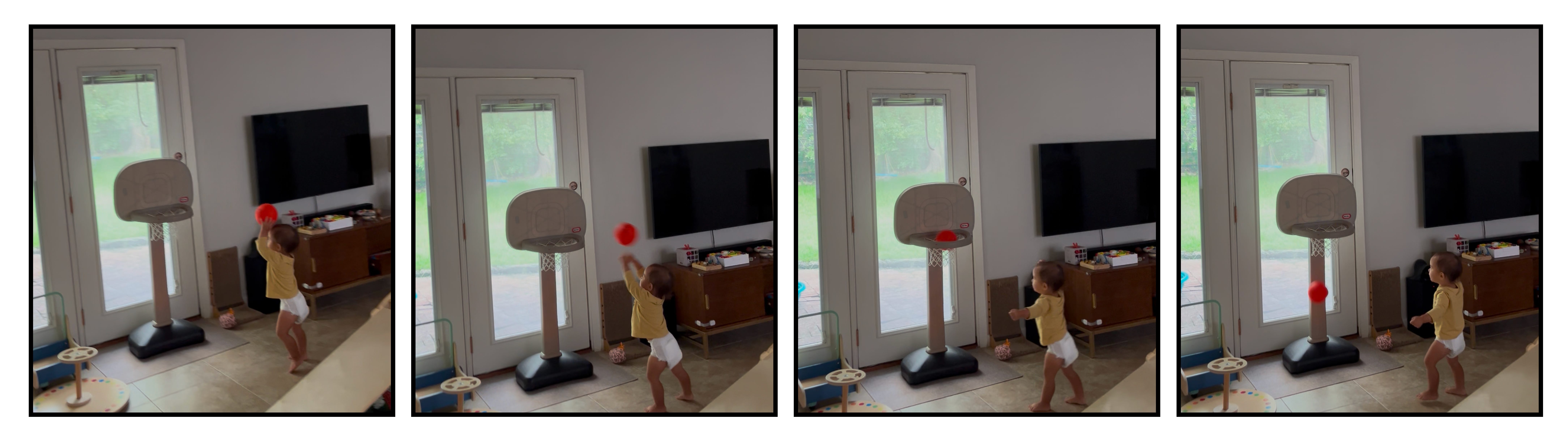
… who’s nearly two years old, has always been fascinated by balls. Basketballs, soccer balls, footballs, volleyballs, and everything in between—when he spots anything sphere- or oval-shaped that can be kicked or thrown, he makes a beeline for it. He’s been like this since he was about 9 months old, when he first started walking. My wife and I are fascinated by this because we did nothing to instigate the behavior. One day, he just decided that balls were his thing. He places the ball where he wants, takes a few steps back, and drills it. When he’s shooting hoops, I see him adjust his hands on the ball and move to the right place in front of the basket before he launches. I see his mind processing what needs to happen. He completely disregards the difficulty of what he’s trying to do and just does it. When he wants to switch feet and kick with the other leg, or throw a ball with the other hand, or do it some other way, he does. It’s awesome stuff. Watching my son learn a skill this way reminds me of the value of not letting past behavior dictate future behavior. It really doesn’t matter how something’s been done before. Whether it’s kicking a ball, writing a book, recording an album, or writing a television show, you can disregard old habits and pre-existing ‘grooves’ and do it a new way. “Habits are statements about the past,” writes Gallwey, “and the past is gone.”

Momentary gladness
Behind the scenes
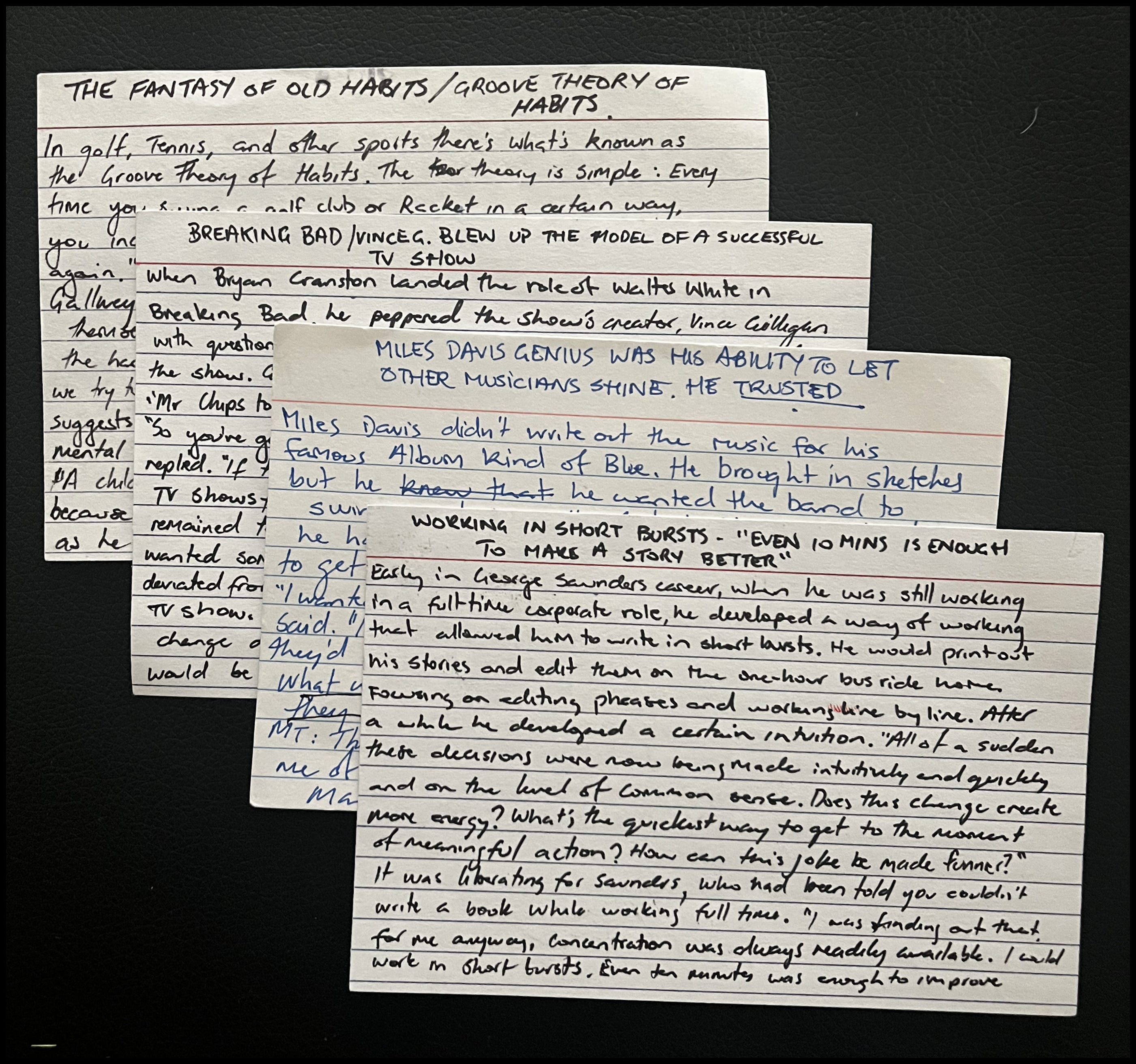
Every post starts with my notecards. I capture anything I find interesting in what I’m reading, watching, or listening to, and later write a notecard to add to my box. When I write a post, I start by picking a couple of notecards that resonate with me and begin working from there. Here are the notecards for this week’s issue: