


It’s Friday night. Late. I’m seated at the kitchen table, hunched over the laptop and tugging at my hair. A blank Google Doc stares back at me.
I let out a sigh.
“You okay?” asks Mel.
“Yeah,” I reply. “Just some writing stuff.”
“What’s it about?”
I respond by talking in circles for a minute.
“...I dunno,” I finally say. “I’m still trying to figure it out.”
When I’m stuck like this, I’ll grab a book from the shelf and see if there’s something in it that can clear out the creative block in my head and spark an idea. Advertising books work well for this. I think it’s because copywriters are idea merchants. They develop new ideas every day, often under tight deadlines. So when I’m looking for a fresh way to approach a creative problem, I’ll usually start with one of the many advertising books I have and get to work. One of the best books for this is The Copy Book: How the Best Advertising Writers Write their Advertising by D&AD. It features 50+ copywriters writing about their creative process. My favorite advice in the book is less about writing and more about thinking and problem-solving:
“Before you open your pad, open five other things. Your ears, your eyes, and your mind.”
“Sit back and sniff around the problem. If you get stuck, walk away from it for a while.”
James Lowther
“Know there’s always a fresh way to tell an old, old story. Standup comedians are brilliant at this, taking the most mundane subject—life—and retelling it in ways that make us laugh, wonder, and think.”
Mary Wear
“The more ideas you come up with, the less obvious the later ones are going to be, if only because you have to avoid repeating those first thoughts so you’re bound to get to a more original idea.
Sean Doyle
“Keep your mind and your notebook open to real life.”
Vicki Maguire
“If good things are going into your head, good things will come out.”
Malcolm Duffy
“Stare out into the cosmos. Remembering how small and accidental you are reminds you that what you’re doing isn’t that serious or difficult.”
Dan Germain
When I ordered the book years ago, I remember hoping that all these brilliant copywriters would reveal the step-by-step process for thinking creatively and developing original ideas. I was naive then, and perhaps holding too high expectations for what one little book could deliver. But re-reading it, I’m surprised to learn there is a process after all.
It’s just not the one I was expecting:
You sit with the problem.
You think about it and work on it.
You work at it from every angle you can think of.
Until a glimmer of an idea shows itself.
And you catch it. And you work on it some more.
And think more about it.
When you’re stuck, you take a break.
When you come back, you keep working on it.
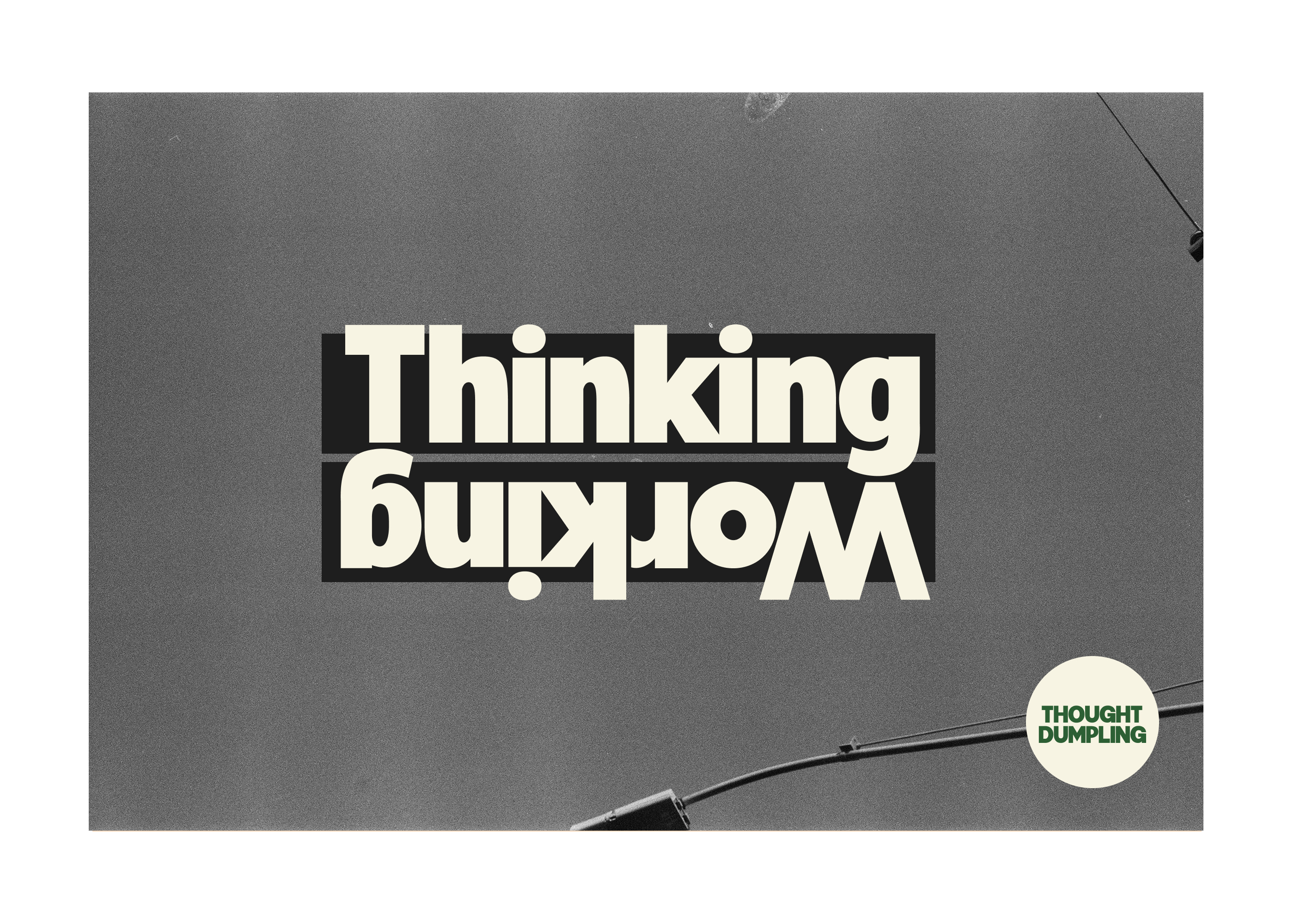
Thinking. Working. Thinking. Working.
Tinkering and shaping the idea into life…
And eventually you have it.
As far as I can tell, that’s the creative process.
I hear steps behind me.
It’s Mel.
“Maybe take a break,” she says. “Go for a walk or something?”
I sit back in my chair. The draft of the article is finished.
There’s more work to do. More thinking.
But it’s a start.
“Yeah,” I say. “Good idea.”